UK EPR Fee Explained: Your 2025–2026 Base Fees & 2026 Modulated Fee Breakdown
Understanding how packaging fees are structured and why they matter for your business
Since 1 January 2025, the UK’s Extended Producer Responsibility (EPR) framework has been fully operational, shifting the full net cost of managing household packaging waste from taxpayers to producers.
Under the Producer Responsibility Obligations (Packaging and Packaging Waste) Regulations 2024 (SI 2024/1332), obligated businesses must collect accurate packaging data and pay fees that reflect the environmental impact of their materials.
The first invoices (based on 2024 data) were issued in October 2025.
For SMEs, knowing how these fees are calculated and how they will evolve is essential for forecasting, budgeting, and compliance.
Base Fees - The Foundation for 2025
In 2025, base fees apply to large producers only, covering the full net cost of household packaging waste collection and recycling.
Producer size thresholds
Large producers:
≥£2m turnover AND >50 tonnes
Submit semi-annually
Pay fees
Small producers:
£1m–£2m turnover AND 25–50 tonnes
Submit annually
Pay no fees yet
Base-fee rates are published annually by PackUK/DEFRA.
Final 2025 Base Fees (per tonne)
(PackUK / GOV.UK, June 2025 - household packaging only)
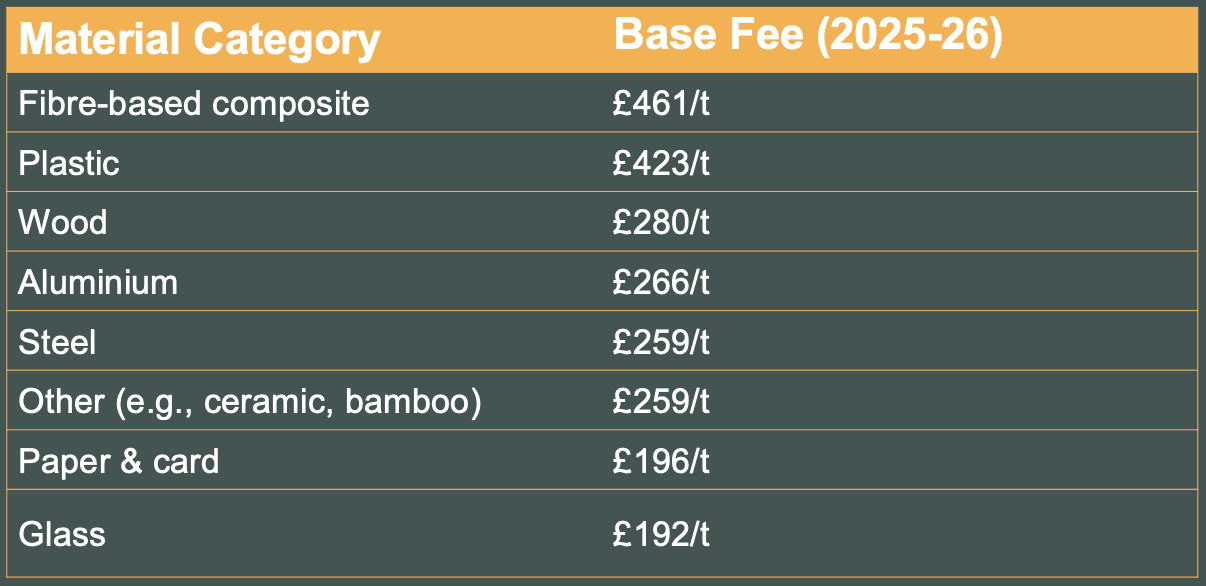
Note: Fees rounded to nearest £1. Full methodology available on GOV.UK.
Base fees apply only in 2025.
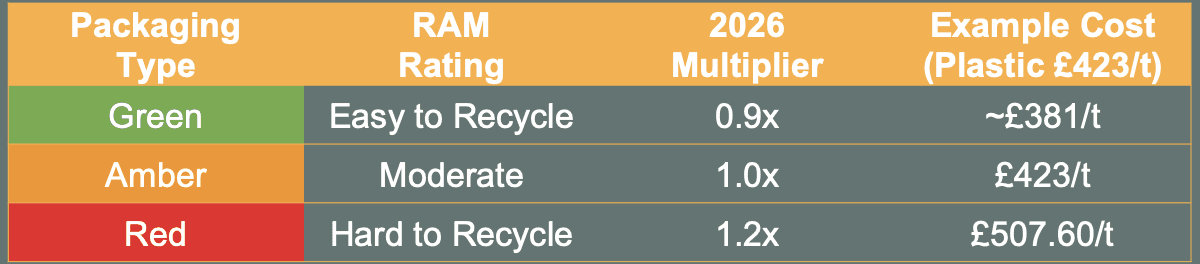
From 2026, producer fees are linked directly to recyclability using DEFRA’s Recyclability Assessment Methodology (RAM).
How modulation works
Green RAM rating → lower fees (discount)
Amber RAM rating → base rate
Red RAM rating → higher fees (premium)
2026 multipliers (initial year)
Green: ~0.9x
Amber: 1.0x
Red: ~1.2x (increases further by 2028/29)
What Determines Your Total Cost
Packaging material type
RAM recyclability score (green/amber/red)
Tonnage placed on the UK market
Packaging format (primary / secondary / tertiary)
Local authority recycling performance
Scheme-wide administrative costs
DEFRA and the Environment Agency will continue refining modulation throughout 2026–2027.
✔ Conduct supplier audits
✔ Set quarterly validation checks
✔ Review Ram classifications
Use the latest RAM guidance
✔ Convert all supplier-verified grams → tonnes
✔ Retain all evidence for 7 years
Supplier weights
RAM justifications
Material codes
BOM breakdowns
✔ Monitor DEFRA/EA updates
Where EPR Horizon Fits In
EPR Horizon helps SMEs interpret fee rules and forecast exposure with clarity.
We provide independent, DEFRA-aligned advisory support:
Data-collection templates aligned to DEFRA categories
Supplier declaration tracking
Support interpreting RAM criteria and embedding them into workflows
Quarterly validation & readiness reviews
7-year “evidence vault” structures
Audit-defence documentation
Summary (as of November 2025)
Base fees apply for 2025
Modulated (recyclability-linked) fees start in 2026
RAM is mandatory for large producers
Fees depend on material, tonnage, and recyclability
SMEs must ensure year-round data integrity
❗ Disclaimer: Guidance accurate as of November 2025. Always check the latest GOV.UK updates.
Need clarity on your packaging data or EPR readiness?
Book Free Readiness Review