EPR Supplier Data: The Blueprint for Audit-Ready Collection & Lowering 2026 Fees
Accurate supplier data is the foundation of UK packaging EPR compliance. From 2025 onward, the Environment Agency (EA) expects producers, especially SMEs, to demonstrate that their data is complete, verified, and traceable. With modulated fees arriving in 2026, the quality of supplier data will directly influence the costs you pay.
This guide explains what data producers must collect, the common pitfalls SMEs face, and the most effective steps to build an audit-ready, defensible data trail.
Any business placing packaging or packaged goods on the UK market may be an obligated producer under the Producer Responsibility Obligations (Packaging and Packaging Waste) Regulations 2024 (SI 2024/1332).
Large producers:
Turnover £2m+ and >50 tonnes packaging/year
Must report bi-annually (H1 by 1 October; H2 by 1 April)
Are liable for EPR fees (modulated from 2026)
Small producers:
Turnover £1–2 million and 25–50 tonnes packaging/year
Submit annually (report-only; no fees until large thresholds are met)
Note: Data collection is continuous, but formal submissions follow these specific cadences.
Record Keeping Requirements
Under the 2024 Regulations, producers must keep all EPR records for at least 7 years from the end of the relevant calendar year.
This includes:
Packaging data
Supplier confirmations
Recyclability (RAM) assessments
Internal validation evidence
This 7-year retention applies across all evidence.
To meet EA expectations and prepare for 2026 fees, producers must gather:
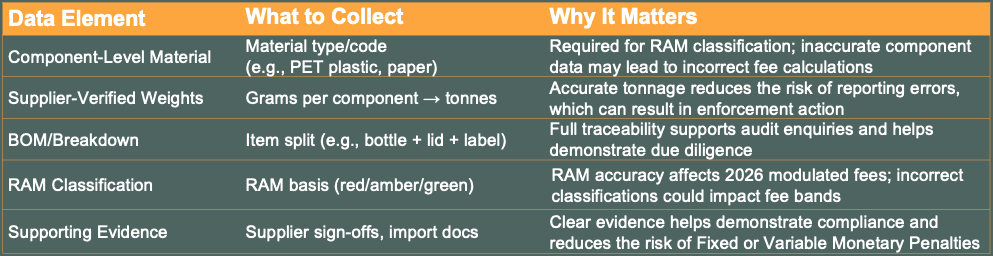
Component-level material type
Supplier-verified weights (in grams → converted to tonnes for submission)
Bill of materials (BOM)/ Breakdown (e.g., bottle, lid, label, adhesive, film)
Recyclability classification using DEFRA’s latest RAM guidance
Evidence supporting each RAM classification
Import documentation where applicable
Activity classification (e.g., imported, packed/filled, brand-owned)
DEFRA's supplier data expectations include:
Material type
Component list
Supplier-verified weights
RAM classification
Supporting evidence
Common SME Pain Points
Inconsistent formats across suppliers (PDFs, emails, spreadsheets, verbal confirmations)
Missing non-UK-specific weight detail (e.g., overseas suppliers omitting grams per component)
Lack of evidence for recyclability claims
Incorrect material classification (e.g., laminated pouches or mixed boards)
Overseas supplier gaps
No evidence trail of validation or checks
Failure to update data after supplier changes
These gaps weaken audit defensibility and may increase the risk of enforcement actions, including Fixed Monetary Penalties (£1,000 → £1,500) or Variable Monetary Penalties (uncapped; based on harm and culpability).
Step 1 - Issue a Standardised Supplier Template
A single format
Mandatory fields
Required evidence types
RAM classification guidance
Step 2 - Verify Weights & Materials
Component weights (g → tonnes)
Materials (mono vs multi-material)
BOM alignment
Document the verification with a short email or form signed by the supplier.
Step 3 - Align All Data with the Latest DEFRA RAM Guidance
This future-proofs your obligations and prepares you for 2026 fee changes.
Step 4 - Build a 7-Year Evidence Vault
Supplier confirmations
RAM evidence
Validation steps
Emails
Internal sign-offs
Corrections
Historic versions
Digital retention for 7 years is now standard practice.
Step 5 - Implement Internal Change Controls
Change packaging
Switch materials
Modify designs
Re-spec components
Track changes with timestamps and approvals.
Step 6 - Maintain a Submission Calendar
4 weeks before deadline
2 weeks before
48 hours before submission
This is a major differentiator between compliant and penalised SMEs.
How EPR Horizon Helps SMEs Stay Data-Accurate & Audit-Ready
Build supplier-data templates and validation workflows
Create RAM-ready component classification systems
Design 7-year “evidence vaults”
Prepare organised evidence packs to support EA enquiries or audits
Establish internal change-tracking systems
Maintain a full compliance calendar
❗ Disclaimer: Always refer to the latest GOV.UK guidance, as EPR rules and fee structures continue to evolve.
Need clarity on your packaging data or EPR readiness?
Book Free Readiness Review